
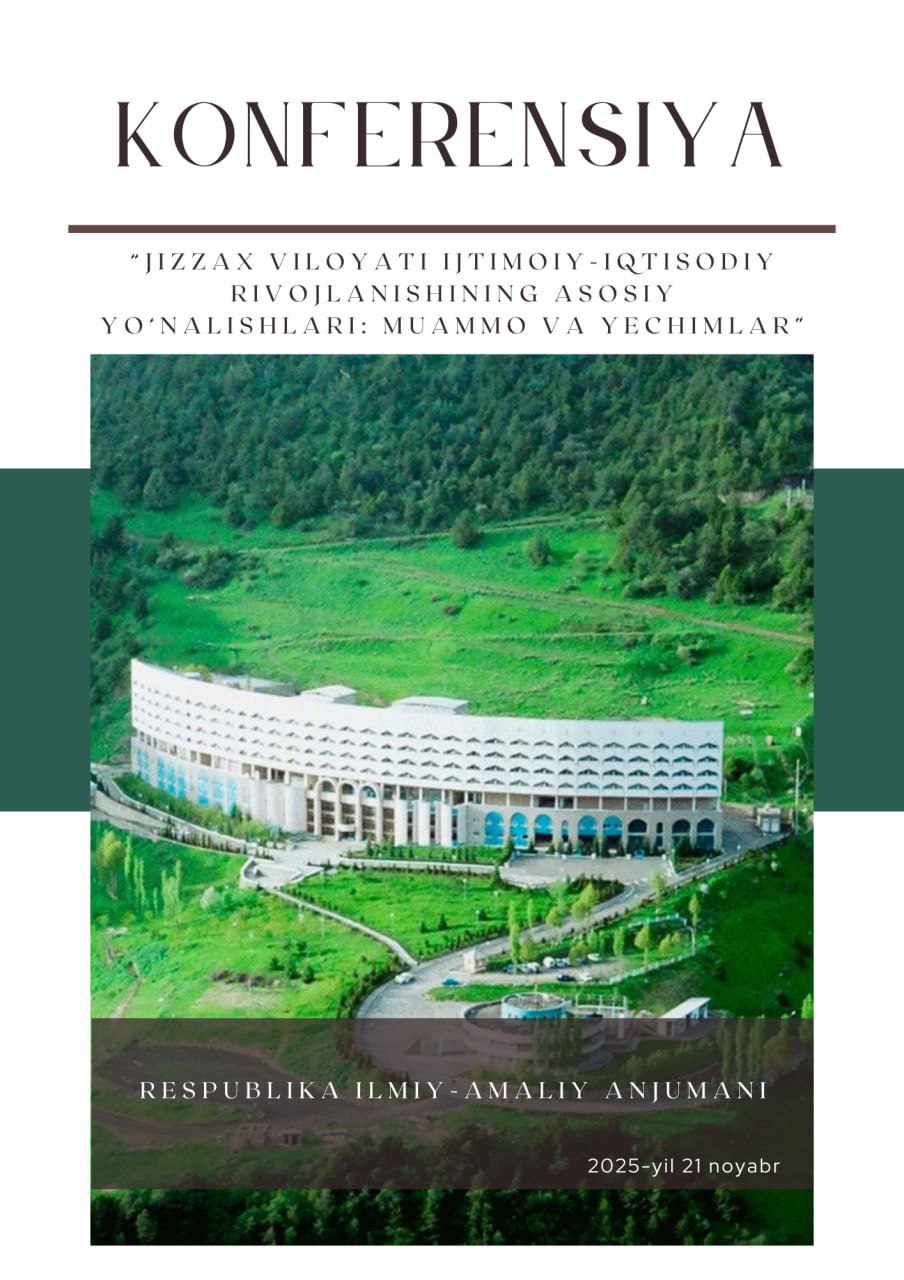
JIZZAX VILOYATI IJTIMOIY-IQTISODIY RIVOJLANISHINING ASOSIY YO‘NALISHLARI: MUAMMO VA YECHIMLAR
Keywords:
Humanitarian education, modern education system, globalization, digital transformation, critical thinking, competence-based approach, innovative pedagogy, cultural values, national identity, moral education, human capital development, educational modernizationAbstract
This article explores the essence of modern humanitarian education, its significance in the development of society, and the current challenges faced by this field in the era of globalization and rapid technological progress. The study emphasizes that the growing influence of digitalization and information technologies has increased the importance of humanitarian sciences in shaping critical thinking, moral awareness, and cultural identity. However, several urgent problems persist, such as the predominance of traditional teaching methods, the insufficient connection between educational content and real-life practice, and the weak development of students’ creative and analytical skills. The paper discusses the need to modernize humanitarian education by integrating innovative pedagogical technologies, adopting a competence-based approach, harmonizing national and universal human values, and enhancing teachers’ professional competencies. The findings suggest that modern humanitarian education serves as a crucial factor in ensuring the spiritual, cultural, and intellectual development of society and in forming the human capital necessary for sustainable progress.
Downloads
References
Bahattab, A., Trentin, M., Hubloue, I., Della Corte, F., Ragazzoni, L. (2024). Humanitarian health education and training state-of-the-art: a scoping review. Frontiers in Public Health, 12, 1343867.
Hayba, E. (2014). Linking education and innovation in humanitarian settings: are they connected? UNHCR Innovation.
International Institute for Educational Planning (IIEP-UNESCO). (2013). The challenges of providing quality education in conflict areas. Paris: UNESCO.
Johnson, P., Smith, A., & Thompson, L. (2023). Higher education for refugees: relevance, challenges, and open research questions. SN Social Sciences, 3, 177.
Smith, J., Brown, K., & Green, L. (2022). Mastering humanitarianism? A survey of postgraduate humanitarian courses. Higher Education, 84(4), 741-760.
UNICEF. (2022). Education in emergencies: ensuring access and quality for all children. New York: UNICEF.
UNESCO. (2021). Global education monitoring report: inclusion and equity in education. Paris: UNESCO.
Clark, D. & Anderson, R. (2020). Innovations in humanitarian education: digital tools and learning outcomes. Journal of Humanitarian Studies, 15(2), 45-63.
Downloads
Published
Conference Proceedings Volume
Section
License

This work is licensed under a Creative Commons Attribution-NonCommercial-NoDerivatives 4.0 International License.